Why Strength Matters More After 50
The National Strength and Conditioning Association says aging, even without chronic disease, is linked to losses in muscle mass, strength and function. Its 2019 position statement calls resistance training a powerful way to counter those losses, with benefits for mobility, independence and quality of life (NSCA position statement, 2019).
The good news is that it is not too late to start. Our main guide to strength training over 50 covers how we coach this age group. This article is the step-by-step version.
Step 1: Talk With Your Doctor
Check in with your doctor before you start, especially if you have a new diagnosis, recent surgery or pain. If you are recovering from an injury, see a physical therapist first and come see us once you are cleared.
Ask your doctor what you are cleared to do and anything to avoid for now. Bring those notes to your first session.
Step 2: Train Twice a Week
The CDC recommends muscle-strengthening activity on at least 2 days a week, working all major muscle groups (CDC). A 2015 meta-analysis of trials in healthy adults 65 and older found that two sessions a week was the most effective frequency for improving strength (Borde and colleagues, 2015).
Two sessions also leave time to recover. Your body gets stronger during the rest between workouts. Two sessions also leave room for the activities you already enjoy, such as walking, golf, gardening or time with the grandkids.
Step 3: Choose Machines and a Coach
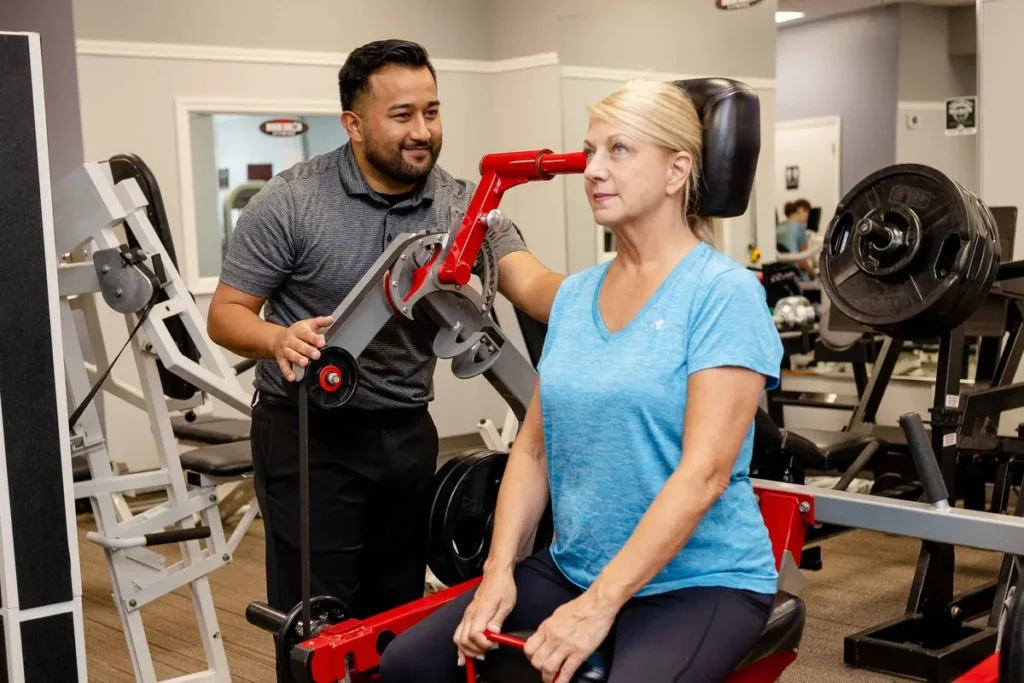
Machines guide the path of each movement, so you can focus on effort. A coach adds the rest: setting up each machine, choosing the weight and watching every rep.
The National Institute on Aging suggests scheduling a session or two with a personal trainer if you are unsure about a movement, and asking your doctor or physical therapist when in doubt (National Institute on Aging).
Start With a Free 45-Minute Introductory Session
Not sure where to start? Your free session includes a coached workout paced for a true beginner.
Step 4: Start Lighter, Then Add Weight
Your first weeks are for learning each machine and finding a starting weight. The American College of Sports Medicine recommends adding a small amount of weight once you can do one or two more reps than your target with good form (ACSM position stand).
At Rock Solid Fitness, your coach records every workout, so you always know what you lifted last time and what to aim for next.
Step 5: Use Slow, Controlled Reps
Slow reps keep the work on your muscles, not on momentum. We take each exercise to the point where one more good rep is not possible, then move straight to the next machine.
The National Institute on Aging also recommends breathing out during the effort and breathing in as you relax, and not locking your arm and leg joints straight.
What Your First Month Might Look Like
Your coach decides the exact plan, but a typical start has three parts. In the first sessions you learn each machine and find a comfortable starting weight. After that, you add small amounts of weight as your form stays steady. By the end of the month, you know your routine and your coach can show you what you lifted in session one compared with now.
Soreness the day after a new workout is common. Sharp pain is different, so tell your coach right away if something hurts in a way that feels wrong.
When to Stop and Call Your Doctor
Stop the exercise and let your coach know if you feel chest pain, dizziness or a sharp pain in a joint. Call your doctor if the symptoms do not go away. Coaches are not a substitute for medical care, and your doctor knows your history best.
What About Bone Density?
In the LIFTMOR trial, 101 postmenopausal women with low bone mass did either 8 months of supervised, high-intensity strength and impact training twice a week for 30 minutes, or a low-intensity home program. The supervised group improved bone density at the lower spine and hip more than the home group (Watson and colleagues, 2018).
That study used close supervision. Talk with your doctor about your bone health, and read more about strength training for bone density.
What to Bring to Your First Session
Wear comfortable workout clothes and gym shoes, and bring a water bottle. Bring any notes from your doctor too, along with a short list of questions. There is a place to leave your things, and bathrooms and a shower are on site.
Questions Worth Asking Your Coach
- Which machines will I use first, and why?
- How will you decide when I add weight?
- What should I do on the days between sessions?
- How will I see my progress?
If You Have Never Lifted Before
You do not need any experience. Coaches set up each machine, choose your weights and pace the first session for a true beginner. Many members start in their 60s and 70s. If you are looking for a parent, see personal training for seniors.
Members train in coached 25-minute sessions in 1-on-1 personal training or with a partner in family personal training.
Our Dunedin studio is two doors to the right of the Walmart at 2110 Main St, Dunedin, FL 34698. We also coach people from Clearwater, Palm Harbor, Safety Harbor and Oldsmar.
Start With a Free 45-Minute Introductory Session
Pick a time in under a minute. Your first session is free and takes about 45 minutes.
Sources
- NSCA: Resistance Training for Older Adults, Position Statement, 2019
- CDC: Adult Activity, An Overview
- Borde R et al. Dose-Response Relationships of Resistance Training in Healthy Old Adults. Sports Medicine, 2015
- National Institute on Aging: Three Types of Exercise
- American College of Sports Medicine position stand: Progression models in resistance training, 2009
- Watson SL et al. The LIFTMOR Randomized Controlled Trial. Journal of Bone and Mineral Research, 2018