

“Quick” Exercises To Strengthen And Firm The Midsection
I originally pitched this information to a national outlet because I believe the “quick core exercises” flooding the internet and people’s social media feeds miss the point entirely, especially for people in their 40s and beyond. Most of these highlighted movements and so called exercises either scare people from flexing their spine, a normal movement and part of everyday life, or suggest exercises with no attention to spinal safety.
Since this piece didn’t run, I thought I would share it here rather than letting it sit in my drafts folder.
When we hit the age of 40 and beyond, the goal isn’t just to work the abs, it is to build a core that stabilizes the spine while you move, without aggravating the joints and discs that have decades of wear on them. These 5 exercises do exactly that AND are ALWAYS incorporated into a full body strength training routine. After all, if the muscles around your spine, your arm and leg muscles, are weak, the load goes right to the spine and create forces that can’t be properly supported leading to injury and pain.
Exercise 1: Abdominal bracing
Lying on your back, find a neutral spine and contract your abdominal muscles to hold the spine in a neutral position. To find a neutral spine, lie on your back, flatten your low back into the surface below you, then arch it and finally relax it. There should be a small space between the surface and your low back. This is your neutral spine and is different for everyone.
Once in a neutral spine, the contraction should be felt all around your abdominal muscles, including the sides.
Try to work up to three minutes without relaxing your brace/abdominal contraction. This sounds easy but most people have difficulty performing the brace while simultaneously breathing.
This is the foundation everything else builds on: it teaches the body to protect the lower back before you ever add movement or load.
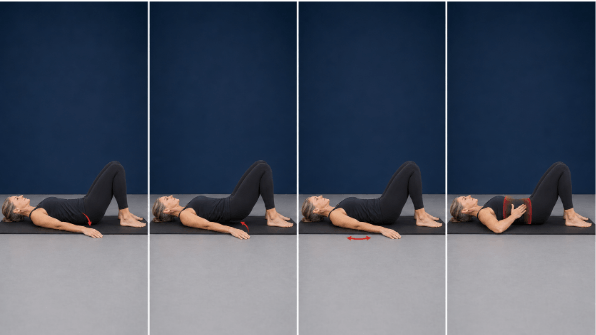
Exercise 2: Dead Bug
Lying on your back, with an abdominal brace as described in exercise #1, lift one leg at a time so that your knees and hips are at a 90 degree angle. Straighten your arms towards the ceiling. Thrust your legs forward one at a time while your arms move in opposition, holding your neutral spine position throughout with your abdominal muscles. It’s a safe, controlled way to build abdominal strength without letting the back arch or the pelvis rock.
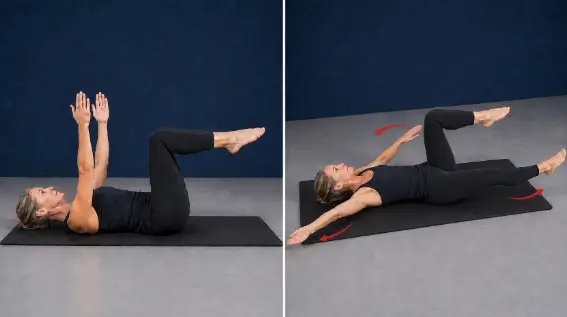
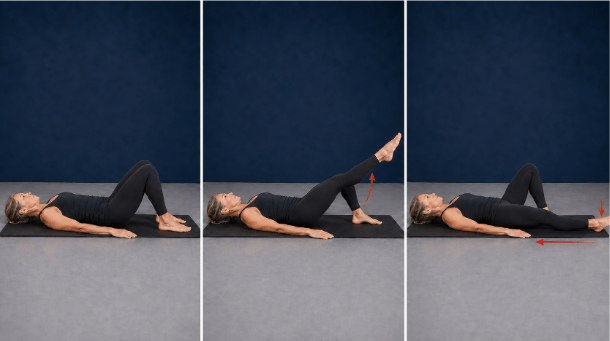
Exercise 3: Supine Leg Extension
An advanced move where you extend and lower one leg at a time. Lie on your back with both knees bent, do an abdominal brace as described in #1, pelvis and lower back in neutral. Straighten one leg from the knee maintaining the same height from the floor. Slowly lower your heel to the floor while maintaining your brace and straight leg. When your heel grazes the floor, slide it back to the starting position. Repeat that with the other leg. You will feel the tension in the lower abdominals. This builds muscular endurance and strength in the lower abdominals without the spinal flexion that traditional sit-ups rely on.
80% of us – 4 out of 5 people – will experience low back pain in our lives. Low back pain is the #1 cause of disability in the workplace worldwide. The cause of most back pain is due to some type of soft tissue injury to the lower back muscles, tendons, or ligaments. We help our members heal, strengthen, and prevent future injuries to the lower back with our strengthening and stretching exercises. They can help you too – and are as simple as taking a few minutes of your day on the floor at home to complete. Take control of your back pain rehab, and prevent future flare ups with these exercises.
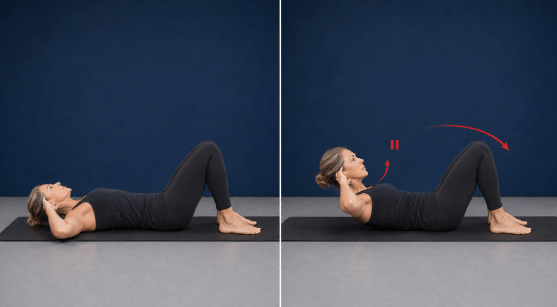
Exercise 4: The floor crunch
Lying on your back, with your finger tips at your ears and your elbows out of sight, lift your head and shoulders as high as possible without lifting your lower back off the floor, while keeping your neck neutral. Rise on a slow 2 second count, pause deliberately for 1 second at the top, then lower for 4 seconds, maintaining tension and range of motion the entire set. This tempo is what makes the exercise effective.
Most people rush it and lose the benefit. These are the people that say they do 100 crunches at a time. They generally use momentum and relax the contraction at the bottom, losing their neutral spine, putting their spine in a vulnerable position and ineffectively training their core at the same time.
Exercise 5: Rotary Torso Twist
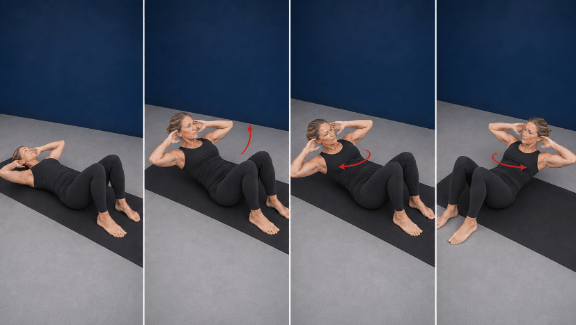
This could be done on a rotary torso machine or lying on your back. If lying on your back, do a crunch as described in #4. When your head and shoulders are lifted off the floor, add a deliberate twist to each side. Do not let your hips lift off the ground. Hold the abdominal contraction isometrically and never release the tension as your head and shoulders return to the floor, neck kept neutral throughout. This trains the obliques and rotational strength that a straight ahead crunch can’t reach, which matters for the movements we make in life like reaching and turning.
I chose these five exercises specifically because they train the deep stabilizing muscles of the core, not just the surface muscles, while keeping the spine in a safe, neutral position throughout, and because the isometric tension and controlled tempo in the crunch and rotary twist make far more difference than the exercise itself.
These exercises are homework for low backs that have chronic pain or injuries. Over the three decades I have been helping people live better functional lives, these exercises, along with an intense, safe full body strength training program, have been proven to alleviate pain.
How home workouts compare to the gym for building a stronger core:
Here’s the honest answer, and it’s a bit different from what the headline suggests: home exercises like these are excellent for building the foundation of core stability, but they’re not actually faster or more effective than gym-based training for building strength, which is key for a firm and strong midsection.
Firming isn’t only about muscle. A firm midsection comes from two things happening together: building real muscle strength through progressive resistance, and reducing the layer of fat that sits over it through nutrition. No exercise, at home or in a gym, burns fat off one specific area. It is hard to find a way to continuously progress resistance at home.
Where the gym wins over home is progression with resistance and safety. Bodyweight core work at home has a ceiling. Once your body adapts, you need added resistance to keep building strength, and that’s much easier and safer to do with equipment and supervision.
Proper form and appropriate loading really matter, especially as we age. This is exactly why at Rock Solid Fitness, our clients build their core strength using High Intensity Safe Strength Training® so progression happens safely and under supervision.
So my honest recommendation is: use these five home exercises as your daily foundation, but pair them with actual strength training and attention to eating whole, nutrient-dense foods if the real goal is a visibly firmer midsection.