


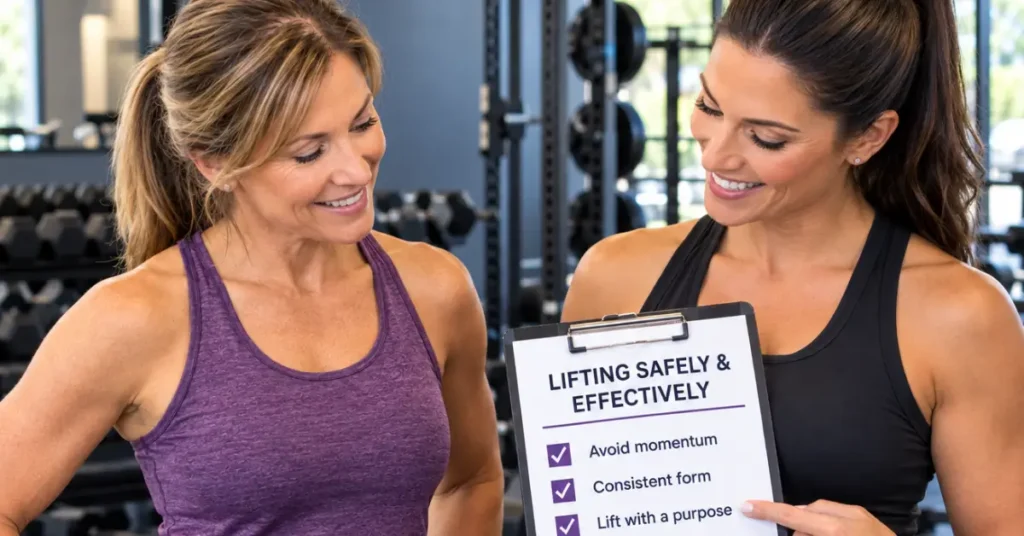
How to Lift Weights Safely, but Effectively
At Rock Solid Fitness, we believe lifting weights is the most effective ways to build strength, increase muscle, improve physical function, and maintain a healthy body built for longevity. But simply picking up a weight and moving it through an exercise does not guarantee that you are getting the results you want, and it doesn’t guarantee that you are performing the exercise in the safest possible way.
How you lift matters.
Your technique, range of motion, speed of movement, resistance selection, and level of effort all influence how productive a strength-training exercise will be. Learning how to lift weights properly means factoring in how to lift weights safely, but also how to make sure you are getting results.
What Does It Mean to Lift Weights Safely?
Proper weightlifting technique is about much more than simply having good posture. An effective repetition should be performed with control, consistency, and purpose.
Lift Safely With Good Control
One common mistake is using momentum to move a weight rather than controlling the weight. When I mention control of the weight, the image that I’m trying to portray is that you are slowly moving the weight, and therefore always feeling a load on your muscles throughout an exercise. One standard speed of lifting that you can apply to almost any exercise is to lift the weight in 2 seconds and lower it in 4 seconds, and going even slower is keeping things on the safe side. Don’t be fooled by what you see most commonly in the gym by others. You’ll often see someone rapidly swinging a dumbbell, bouncing through a repetition, or allowing a weight to drop uncontrollably after lifting it.
There are a few problems with incorporating momentum in your lifts. First, the strain on your soft tissues is much greater. Changing directions in particular is the largest area of concern. If speed or momentum is used to lift a weight, then your muscles and tendons need to apply a great force all of a sudden to stop at the end of the range of motion. Alternatively, if you don’t control the weight on the lowering phase, then you need to apply a great force to change direction to begin the next rep’s lifting phase. These sudden fluctuations with force increase risk of injuries on your muscles, tendons, and ligaments compared to the steady, equal force that is applied when always under control of the weight.
A second problem with using momentum is that when momentum takes over, the exercise can become less effective at challenging the muscles it was intended to train. Only two forces are being used to lift weights; your muscles contracting is one force and momentum is the other force. When the force of momentum is increasing, the force of your muscles contracting is decreasing. Therefore, the less momentum you are incorporating results in a greater challenge to your muscles, which results in greater results.
A greater challenge to your muscles also means that the weight that you need in order to challenge your muscles appropriately is less. Needing less resistance, while still getting an equal or greater challenge on your muscles, means that you can decrease risk on your tendons and ligaments while exercising as well. All in all, avoiding momentum and lifting with control is beneficial to keep your body safe while still getting results for improved strength and muscle gain.
Lift Safely With Consistency
When performing a set of 10 repetitions, for example, it is easy for the first few to be performed with proper form while you are still full of strength and energy. The challenge comes in when the hard repetitions at the end of the set are being performed. When you are feeling more exhaustion in your muscles, are out of breath, and are wanting to stop the exercise. The benefit of lifting weights only comes from the challenge at the end of the set, so you shouldn’t stop when the going gets tough. However, when you are pushing through the tough repetitions your body will want to “cheat” in order to make completing a repetition easier.
It is counterintuitive for your body to perform a movement by making it harder on yourself. You naturally will be inclined to use body leverage by changing your posture, to speed up your rep speed in order to not get stuck, or to take microbreaks between your reps in order to rest and recover the muscles you are using. Mental fortitude is required to push through these obstacles to finish your set with the same form as you began with. The benefit of exercising with a personal trainer or partner cannot be overstated when it comes to finishing sets strong. At Rock Solid Fitness, we recognize the importance of the end of the set and coach each member strictly to maintain form as exercises reach the conclusion in order to stay safe and not quit an exercise early.
Lift With A Purpose
Every day is different. Your strength, your energy, and your desire to exercise varies throughout the year. Some days, just going through the motions and checking off the box of going to the gym seems like a victory. But, simply going through the motions defeats the purpose of your workout routine.
The purpose of your weight lifting workout should be to make the most of your time in the gym. Why workout for an hour when you can get the results you desire in 25 minutes? Why go to the gym 5 days per week when only 2 days per week is enough?
Working with a personal trainer not only holds you accountable with your form, but also holds you accountable with your effort. No matter what your energy is, you can push yourself to your current capacity. On the days that you feel weaker, or have less motivation, having a personal trainer push you to your limits gets the most out of your time. At Rock Solid Fitness, our fitness coaches are professionals at motivating members to do better than they think possible. The accountability to do your best rather than slack off pays off big time over time. Your time is valuable, so we ensure you don’t waste it when you’re working out.
Choosing The Correct Resistance
More weight isn’t always better. Another common misconception is that heavier weights automatically produce better results. They don’t.
The right amount of resistance is the amount you can control while maintaining proper technique and effectively challenging the intended muscles. If the weight is so heavy that you have to twist, swing, bounce, shorten the movement dramatically, or recruit other body parts just to move it, you may actually be reducing the quality of the exercise.
Does doing 5 repetitions with 100 pounds create better results than doing 10 repetitions with 80 pounds? Or vice versa? Well, the answer doesn’t really come down to the weight of the resistance, nor how many repetitions you perform. There is no magic formula with those numbers to produce the best results. The answer truly comes down to one word – Intensity.
What Is Intensity?
We define exercise intensity based on how much more you could have done when you finish an exercise. If you reached your limits and cannot have done any more repetitions in an exercise, you will give your body the greatest reason to adapt. If you finish an exercise with the thought, “I could have done two more if I HAD to”, then you are leaving the most valuable repetitions on the table.
In strength training, quality of effort is more important than simply chasing a bigger number on the weight stack. Although you want to see strength increase over time, and the amount of weight you’re able to lift over time increase, we focus more on exercise intensity rather than how much weight you have on an exercise.
Choosing the correct resistance comes down to a few factors. First, you don’t want to choose something so heavy that you are putting yourself at risk of injury by trying to lift something greater than what you are capable of. Alternatively, you don’t want to choose a weight that is so light that it will take you 5 minutes on an exercise to properly challenge your muscles to adapt. The sweet spot that we have found in our exercise programming is a weight that fatigues you on an exercise in about 1 minute to 90 seconds of performing an exercise properly.
Again, this isn’t a magic formula, or the only correct answer. This is just a general recommendation of a weight that we find isn’t too heavy that our members can’t handle it, nor is it too light where too much time is spent on a single exercise. We are shooting for a resistance that is safe, while allowing you to give your muscles a reason to adapt.
Why Your Muscles Need a Reason to Adapt
There is an important principle behind effective strength training: your body adapts to the demands placed upon it.
Your body constantly works to maintain a relatively stable internal environment, a concept known as homeostasis. It does not make significant changes simply because you decided to exercise. It ideally is working to not change at all. It only adapts when it has a reason to.
Think about what happens when you spend time in the Florida sun. Your body recognizes that prolonged exposure to sunlight creates a stress it needs to respond to, and it produces a tan as part of its protective response.
Strength training works according to a similar principle.
When your muscles are exposed to a level of resistance they are not accustomed to handling, the body has a reason to adapt. With appropriate recovery and nutrition, those adaptations can include becoming stronger and increasing muscle tissue.
That is why simply going through the motions of a workout isn’t enough.
Your muscles need an effective stimulus.

Even with the perfect workout routine, your results are determined by your habits outside of the gym. The 4 keys to optimal health are to train right, eat right, rest right, and manage your stress right. It takes a balance of all 4 to get your optimal health. If you are working out, but don’t have the results you are striving for, you may just need to tweak your habits outside of the gym. We have a series of tips to help you get on track with your goals without overcomplicating things.
Muscle growth requires progressive overload.
That doesn’t necessarily mean dramatically increasing the weight every workout. It simply means gradually asking your muscles to do more than they were previously capable of doing.
That progression can come in several forms, but one of the simplest methods is increasing repetitions before increasing resistance. For example, imagine you’re performing an exercise using 150 pounds and currently reach muscular failure at 8 repetitions. Over time, your strength improves. Eventually, you can perform 9 repetitions. Then 10.
Once you can exceed your target repetition range with that weight, it may be time to increase the resistance. The additional weight once again creates a greater challenge, and you begin working your way up again.
This creates a continuous cycle: Challenge → Adapt → Increase the Demand → Adapt Again.
Without progression, the cycle eventually stops.
Why Training Intensity Matters
For your body to recognize that additional muscle is necessary, you have to challenge your existing capacity. This doesn’t mean every workout needs to leave you exhausted for hours or unable to function the next day. It means that the working set needs to be demanding enough to create a meaningful stimulus for the muscle being trained.
At Rock Solid Fitness, this is why we emphasize focused, High Intensity SAFE Strength Training rather than simply accumulating more sets, exercises, or time in the gym.
The goal isn’t to do more for the sake of doing more. The goal is to make the work you do count. When a muscle is pushed close to its current limit, you create a much stronger reason for your body to adapt than if you repeatedly stop well within your existing capabilities.
Once your body adapts, the process begins again. You gradually increase the demand and give your body another reason to become stronger.
More Exercise Isn’t Always the Answer
When people stop seeing progress, their first instinct is often to add more. More exercises. More sets. More workouts. More time spent in the gym. But more isn’t automatically better.
If the additional work doesn’t increase the meaningful demand placed on your muscles, you’re simply doing more of what your body has already adapted to handle. Progress doesn’t come from endlessly repeating what you’ve already proven you can do. Progress comes from challenging your body to do something it isn’t fully prepared to do yet.
That is why tracking your workouts and measuring progress is so valuable. Without knowing what you did last time, it’s difficult to know whether you’re actually asking your body to do more this time. Even small improvements matter. One additional repetition, a slight increase in resistance, or completing the workout routine with less rest between exercises can all represent progress.
Those small improvements accumulate over time.
Your Body Isn’t Working Against You—It’s Being Efficient
It can be frustrating when muscle doesn’t seem to come easily. But your body isn’t trying to prevent you from getting stronger. It’s simply efficient.
Muscle requires energy to build and maintain, so your body won’t invest in additional muscle tissue without a good reason. Your current muscle mass must become insufficient for the demands you’re placing upon it.
That’s your job in training. You have to give your body a reason to change. Challenge your muscles. Work toward the limits of your current capabilities. Track your performance. Progress when you’re able. Then allow your body the recovery it needs to adapt.
The secret to gaining muscle isn’t finding a magic exercise, the newest workout trend, or spending endless hours in the gym. It’s consistently giving your body a reason to become stronger than it is today. Because when your body is forced to choose between remaining the same and adapting to meet a new demand, it has only one logical choice:
Adapt.
Rock Solid Fitness specializes in safely training members in Dunedin, Oldsmar, and surrounding areas. We help ensure stimulating muscles to grow by pushing our members to an intensity that they wouldn’t be able to achieve working out on their own. If you’d like to experience a workout that will get you results, and won’t waste your time working out without gaining muscle, book a free experience with us using the button below.