


When Flexibility Becomes the Enemy: What People with EDS Need to Know About Strength Training
For most people, flexibility is considered a good thing. Fitness programs often encourage people to stretch further, move deeper into positions, and push the limits of their range of motion. But for people living with Ehlers-Danlos Syndrome (EDS), the rules need to be different, or else the problem gets worse.
In fact, one of the biggest mistakes people with EDS can make is participating in exercise programs that continually push joints to their end ranges of motion.
As a Physical Therapist Assistant and Founder and CEO of Rock Solid Fitness, I have worked with several individuals diagnosed with Ehlers-Danlos Syndrome over the years. They were told to “be careful,” to “listen to their body,” and sometimes to avoid exercise altogether. A few had tried yoga or group fitness classes, hoping to feel stronger and more in control, and had ended up in more pain than before. They weren’t doing anything wrong, exactly. The programs just weren’t designed for them.
While every person presents differently, there is one common truth: their bodies need stability from strength more than they need flexibility.
What Is Ehlers-Danlos Syndrome?
Ehlers-Danlos Syndrome refers to a group of inherited connective tissue disorders that affect the body’s ligaments, tendons, skin, blood vessels, and other tissues throughout the body. Roughly one in 5,000 people live with it. Due to an altered state of collagen, joints often become excessively mobile or “hypermobile.” While this increased flexibility may appear advantageous, the cost is a lack of joint stability.
The problem is not simply that joints are loose. It is that the nervous system adapts to that looseness. Muscle recruitment is frequently atypical, with some muscles recruiting too little or too late, while others recruit too much or too soon. The passive structures of the body, the ligaments and joint capsules, cannot be fully counted on to do their job, so the body has to compensate in order to stay stable. This becomes exhausting, often painful, and over time, it leads to the kind of chronic dysfunction that can significantly reduce quality of life.
Many individuals with EDS experience joint hypermobility, frequent sprains and strains, subluxations or dislocations, chronic pain, fatigue, muscle weakness, and poor proprioception, which is a reduced awareness of joint position. The body compensates by relying heavily on muscles to provide the stability that ligaments and connective tissues cannot adequately supply.
Some Traditional Exercise Can Make Symptoms Worse
Many popular fitness programs emphasize stretching. Yoga, certain group fitness formats, and popular mobility-focused training methods take joints to their limits of range of motion repeatedly. For a hypermobile person, that is not a beneficial or therapeutic stimulus. It is a liability.
When a joint already moves beyond its ideal range, repeatedly pushing it further may increase instability. Over time, excessive stretching can contribute to greater joint laxity, increased pain, and a higher risk of injury.
This does not mean individuals with EDS should avoid exercise. Quite the opposite. It means they should focus on the right kind of exercise.
An Important Note for Those with Vascular EDS
Vascular Ehlers-Danlos Syndrome (vEDS) is a specific subtype that carries unique cardiovascular risks because it can affect the walls of blood vessels and internal organs. High-intensity exercise that significantly elevates heart rate and blood pressure carries a different risk profile for vEDS than for other subtypes. If you have been diagnosed with vascular EDS, please obtain medical clearance from your physician and work only with a trainer or therapist who understands your specific diagnosis and can design a program within the parameters your care team has established. This is not a reason to avoid exercise. It is a reason to be especially thoughtful about who guides you and how.

Want to set up your own workout routine in the gym? We’ll help you train on your own to get results, to save time, and to stay injury-free. Get started with all you need to know to apply our High Intensity SAFE Strength Training® in your own gym and on your own time.
Think of Muscles as Range Limiters and Joint Stabilizers
When muscles become stronger, they help control movement and support joints throughout daily activities. Improved muscular strength helps reduce excessive joint movement, improves balance, enhances function, and increases confidence during movement. The muscles surrounding a hypermobile joint are the joint’s best defense against subluxation, dislocation, and the chronic microtrauma that accumulates when joints are repeatedly pushed beyond a safe, controlled range.
Research has reported improvements in joint stability and body pain with strengthening and stability exercises in hypermobile populations, including significant improvements in proprioception and pain with closed chain and proprioception-focused exercise programs. Strength training that is properly designed addresses both the muscular deficit and the neuromuscular one. For more, visit the Ehlers-Danlos Society.
For many individuals with EDS, building muscular strength creates a stronger support system for the entire body and the mind.
Why Program Structure Matters as Much as Resistance
Not every strength training program is appropriate for someone with EDS, and the distinction goes beyond range of motion. Ballistic movements, exercises that rely on momentum to move a load, and any training that uses speed to compensate for control place significant and unpredictable demands on hypermobile joints. When a joint moves quickly through its range without muscular control anchoring that movement, the risk of subluxation or microtrauma rises considerably.
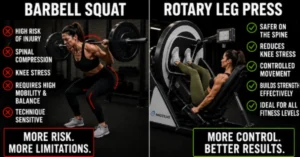
This is precisely why High Intensity Safe Strength Training® uses slow, controlled movement throughout every repetition. Slowing the movement down eliminates momentum as a factor, which means the muscles, not gravity or speed, are doing the work at every point in the range. For someone with EDS, controlling resistance is not just a technique preference. It is a safety requirement. It is also what makes the training genuinely effective, because the muscle has to engage fully and continuously rather than disengaging and letting momentum and gravity do the work on the way down.
The Rock Solid Fitness Approach
At Rock Solid Fitness, every program we design is individualized, data-driven, and intentional. Intention means knowing what a given exercise is asking of the body, and why, and whether the person in front of you has the stability to meet that demand safely. For clients with EDS, that means careful range-of-motion parameters, close attention to joint position during each movement, and a consistent focus on building the muscular support system before adding load or complexity.
Someone with EDS can work hard and still be harmed by the wrong kind of work. The measure of a good session is whether the client becomes more stable, more capable, and more confident in their body than when they walked in, not whether they have bigger muscles and more range of motion.
Safe exercise, in my world, means asking one question: is the risk worth the reward? If the answer is no, I don’t do it. Exercise should help you, not hurt you. It needs to be appropriate for the individual, performed in a range that supports rather than stresses the joint, progressed intelligently over time, and tracked so that we can see objectively whether it is working. It does not mean easy, and it does not mean avoiding challenge. If it doesn’t challenge you, it doesn’t change you. And that challenge needs to meet the body where it currently is and progress carefully and deliberately.
For clients with EDS, that approach has made a real difference. Not overnight, and not without a step back, because EDS is a complex, lifelong condition. But over time, with consistent, properly structured strength work and great two-way communication, people move with more confidence, experience fewer joint events, and reclaim activities they had given up on. That is profoundly changing someone’s life, and it is what my team and I love doing.
You Are Not Too Fragile to Train
If you have been diagnosed with EDS, or if you suspect hypermobility is affecting your quality of life, hear this clearly: strength is not dangerous for you. The wrong kind of movement, performed without awareness or expertise, is. There is a significant difference between the two, and you deserve a coach who knows it.
If you are ready to explore what safe, individualized strength training could do for your body, we would love to talk. [Contact us here] to schedule a complimentary consultation with our team.
For more information on EDS, visit the Ehlers-Danlos Society.