

The Barbell Squat Is Not The Gold Standard. It Never Was.
I am always surprised, no, shocked, when I hear healthcare professionals recommend the barbell squat as an excellent exercise to build functional strength. I used to find myself getting angry when I heard these same people advocate it as the best exercise for longevity and health. I have heard them explain that if a person gets injured, especially repeatedly, they are simply doing the lift incorrectly and need to use lighter weights. But wait, isn’t that the exact opposite of how you build strength? You cannot load muscles with enough resistance to create an adaptation and simultaneously keep the load light enough to avoid injury. You cannot have it both ways.
I have been in the fitness and rehabilitation world for over three decades. I am a Physical Therapist Assistant by training, and I have worked with thousands of bodies, real bodies, not the “how the body is supposed to move” models that populate research studies. What I have witnessed consistently is this: very few people can maintain the form required for a safe barbell squat at a load heavy enough to actually matter. And that is not a weakness. It is anatomy, mobility, history, and the reality of how most people live in their bodies.
So before you load a barbell on your back because someone in medical scrubs or a person with big muscles told you it was the key to a long life, let’s have an honest conversation.
The Gold Standard Revolving Door
The fitness and medical world has a pattern. Every few years, a new marker emerges as the single best predictor of longevity, and everyone pivots. I have watched it happen again and again over my career. There was the MET score, your metabolic equivalent of task, which measured cardiovascular fitness and was heralded as the definitive window into how long you would live. Then grip strength received the spotlight, and suddenly everyone was squeezing dynamometers in their doctor’s office. The Real Age test had its moment, promising to tell you how old your body truly was based on a constellation of lifestyle factors. VO2 max had its run. And now, the glutes. Specifically, glute strength has emerged as the current predictor of mortality, the muscle group that determines whether you will be vital and independent in your later years or fragile and declining.
I am not dismissing any of these markers. Each one captures something real and meaningful. But the pattern itself should give us pause. Science is always evolving, the consensus is always shifting, and the fitness industry has an extraordinary talent for taking a legitimate finding and turning it into a universal prescription that ignores the individual in front of them.
The barbell squat has enjoyed hero status in this world for decades. And I understand why. On paper, it is a remarkable exercise. It recruits over two hundred muscles, loads the entire posterior chain, and when performed correctly, it is a genuinely powerful training stimulus. The operative phrase is “when performed correctly.”
The Anatomical Checklist
What the research studies that justify the squat rarely tell you is who their subjects were. Trained athletes. Competitive powerlifters. People under close coaching supervision performing the lift in controlled laboratory conditions. That is not most people. The prerequisites for a safe, heavy barbell squat are significant: adequate ankle dorsiflexion, hip mobility, thoracic extension, strong abdominal and back muscles for central stability, and the neuromuscular coordination to maintain all of those simultaneously under load, while fatiguing, across multiple sets. Most people are missing several of those on their best day.
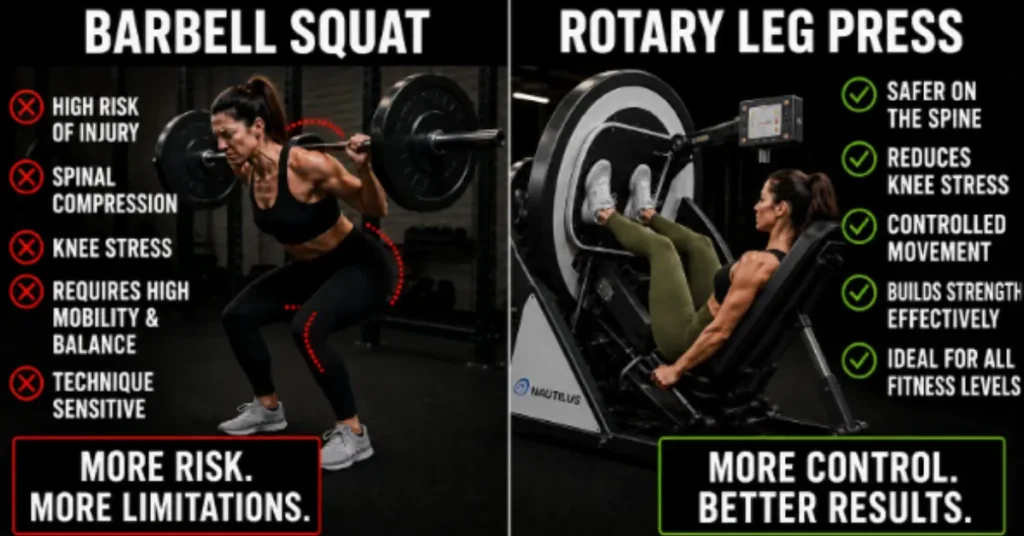
Here is what compounds the problem. A light barbell squat with modest resistance is forgiving enough that compensations rarely cause serious harm. But to drive the kind of adaptation that actually changes the organism, that builds the bone density, the muscle mass, the glute strength everyone is suddenly so excited about, you need real resistance. And at a sufficient resistance, the form breakdowns that were tolerable at low loads start to cause real damage. The lumbar spine is now under significant compressive and shear forces. The knees are absorbing load through compromised mechanics. The body is doing what bodies always do under duress: it is finding a way to complete the movement by recruiting from structures that were never meant to carry that load.
80% of us – 4 out of 5 people – will experience low back pain in our lives. Low back pain is the #1 cause of disability in the workplace worldwide. The cause of most back pain is due to some type of soft tissue injury to the lower back muscles, tendons, or ligaments. We help our members heal, strengthen, and prevent future injuries to the lower back with our strengthening and stretching exercises. They can help you too – and are as simple as taking a few minutes of your day on the floor at home to complete. Take control of your back pain rehab, and prevent future flare ups with these exercises.
Sparing The Spine
The people who get hurt quietly stop squatting. The studies do not follow them. You still need to load those muscles. You still need real resistance. You just do not need a barbell on your back to get there.
If the goal is to strengthen the lower body, load the glutes and quads and hamstrings with enough resistance to create meaningful muscular adaptation, and do it without asking the lumbar spine to serve as a load-bearing support under a heavy bar, then a well-engineered leg press exercise machine is a smarter solution.
In a properly set up leg press, the spine is supported and neutral. The pelvis is stabilized by the seat. The resistance can be substantial, genuinely challenging, because the limiting factor is the strength of the legs themselves, not the ability to stabilize a barbell on a fatiguing spine. You can push hard. You can push heavy. You can chase the strength you are actually after without the injury risk that comes with asking most real human bodies to do something they were never set up to do well.
Results Without Risk
This is what exercise engineering means at Rock Solid Fitness. It is not about making training easier. It is about designing the stimulus precisely, removing the variables that add risk without adding value, and delivering that stimulus to the tissue you are actually trying to change. The glutes do not know or care whether the resistance came from a barbell or a leg press machine. They respond to load and progressive overload. Period.
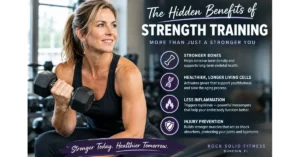
Strength training is one of the most powerful interventions available to the human body, especially for women moving through midlife and beyond. It protects bone density. It preserves muscle mass. It keeps you independent, capable, and vital in ways that no other single health behavior can fully replicate. The stakes are too high to gamble that outcome on one lift that most people cannot safely perform at the loads required to produce it.
Strength Equals Longevity
The metric will change again. Something new will emerge as the next great predictor of how well and how long you will live. But the underlying truth will remain the same: the body that is strong, the body that has been trained deliberately and safely over time, is the body that thrives. How you get there matters. Getting hurt along the way disrupts your life in ways you cannot always recover from.
Train smart. Train hard. Just not with a barbell on your back if your body is telling you it was never designed for it.
If your training has been leaving you hurt more than it has been leaving you stronger, it might be time to ask whether the problem is you, or your exercise selection and performance. At Rock Solid Fitness, every session is built around exactly that question. If you are ready to train hard and train smart, we would love to show you what that looks like. Join our community of members who have found a smarter fitness solution in the Dunedin, Palm Harbor, and surrounding areas.