

What makes the best exercise equipment for strength training?
Knowing what makes one piece of exercise equipment better than another isn’t common knowledge. To most people, machines can look nearly identical, and the differences in how they are designed, and how those differences affect your body, aren’t obvious.
Most people choose equipment based on familiarity, popularity, or what they see other people using. But the equipment that is most popular isn’t necessarily the equipment that provides the safest or most effective way to train a muscle. The fact is, as long as you are working hard, you can improve strength and body composition on any equipment, or even without any equipment just using body weight. Even fitness professionals often continue using equipment they’ve used for years or were introduced to early in their careers despite there being better options.
At Rock Solid Fitness, we believe the best exercise equipment for strength training should do more than simply provide resistance. It should help you train your muscles while minimizing unnecessary stress on your joints, spine, and other structures. It should also be engineered to get the most out of the targeted muscles throughout the range of motion of the exercise.
Where is the weight distributed?
The first factor we consider when choosing an exercise and the equipment used to perform it is safety. You can’t get stronger or improve your body composition if an injury keeps you from training.
Some exercises are so popular, and produce such obvious results, that nobody stops to ask whether there is a better way to achieve the same result. A good starting question is: Where is the resistance being placed on the body, and is that a reasonable place to put it?
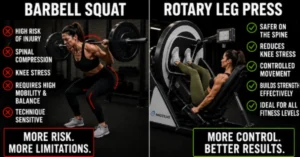
Take the barbell squat for example. Imagine someone is doing a barbell squat with 135 pounds on the bar. That amount of resistance may be appropriate for challenging the muscles of the legs and hips that the squat is targeting, but the load is also being transmitted through the upper body and spine.
The barbell squat doesn’t simply challenge the quadriceps, hamstrings, and glutes. The lifter must also support and stabilize the load through the shoulders, trunk, and spine while maintaining balance and body position throughout the movement.
The question isn’t whether a barbell squat can strengthen the legs, as it clearly can. The question is whether placing all of those additional demands on the body is necessary to effectively train the target muscles. If you can challenge the same muscles with equipment that provides greater support and control, while reducing unnecessary loading elsewhere, that may be a better choice.
Avoid Going With The Flow
A fit-looking person may know a great deal about exercise, or they may simply have found something that works well for them. Their results alone don’t tell you whether the exercise they’re performing is the safest, most efficient, or most appropriate choice for everyone else.
There are many ways to build muscle and improve body composition. The fact that a particular exercise has worked for someone doesn’t automatically make it the best choice for you.
Don’t be fooled into thinking brawn equals brains.
Instead, ask a better question: Is there a way to train the same muscles effectively while reducing unnecessary risk or stress on the body?
Does the Equipment Help Maintain Proper Posture?
Free weights like barbells, dumbbells, and kettlebells are convenient, versatile, and relatively inexpensive. One piece of equipment can be used for dozens of different exercises, and free weights don’t require much space.
The tradeoff is that the equipment provides little assistance in controlling your body’s position. The lifter is responsible for maintaining alignment, controlling the movement, and determining how far the exercise should go. When the goal is to safely and efficiently challenge a specific muscle group, we should ask whether all of that additional stabilization is actually necessary.
Consider the barbell squat again. The lifter must maintain spinal position, control the knees and hips, maintain balance, and coordinate the movement while supporting an external load.
Every person’s anatomy, mobility, injury history, and training experience is different. A movement that feels comfortable and appropriate for one person may not be appropriate for another.
That doesn’t mean the squat is inherently bad. It means that an exercise should be evaluated based on the individual performing it, not simply because it is popular or considered a “fundamental” exercise.
When equipment can help maintain appropriate alignment and provide greater control over the movement, it can reduce some of the demands that aren’t directly related to the muscles you’re trying to strengthen.
Stabilizing Muscles Aren’t The Whole Point Of An Exercise
One of the most common arguments in favor of free weights is that they require more stabilization. The idea is that because a machine helps support and guide your body, it must be preventing your stabilizing muscles from getting stronger.
There is some truth to the fact that free-weight exercises require more stabilization. But that doesn’t inherently make them better for the goal of your training. If the goal of your squat is to strengthen your leg muscles, then why worry about the use of completely different muscles? Those abdominal and lower back muscles can be strengthened better in a different exercise that specifically targets them.
One of the basic principles of strength training is progressive overload. For a muscle to become stronger, it needs to be challenged sufficiently in order to stimulate adaptation. If your goal is to strengthen your quadriceps, hamstrings, and glutes, you can get more direct benefit from an exercise that allows those muscles to be challenged without balance and stabilization from other muscles being a limiting factor.
Feeling your lower back after performing a squat doesn’t necessarily mean you are strengthening it effectively. It may just mean that your lower back is being asked to stabilize and support the movement. If strengthening the muscles of the lower back is the goal, those muscles can be trained directly with an exercise designed specifically for them.
Does the equipment allow limiting range of motion?
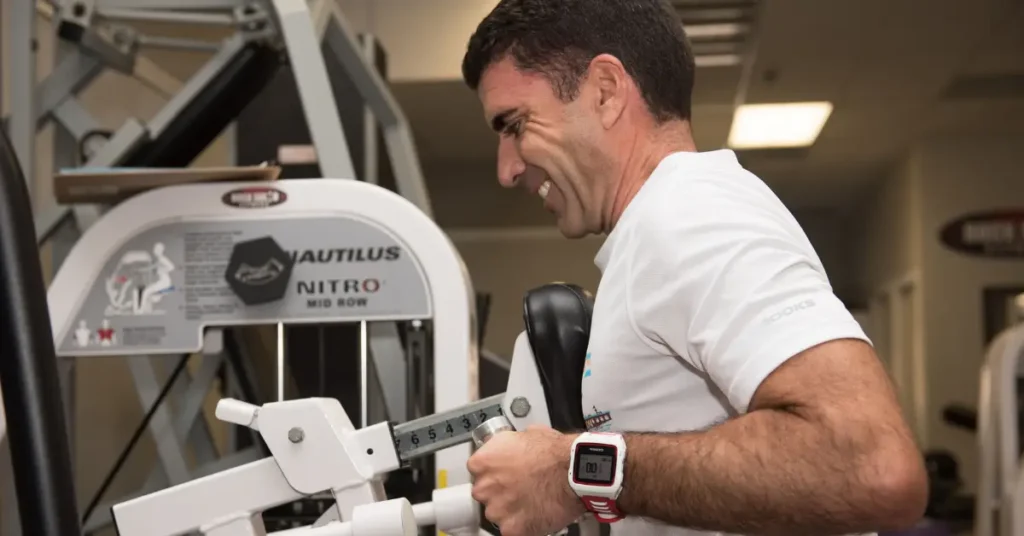
The appropriate range of motion on a given movement or exercise is different for everyone. Anatomy, injury history, and flexibility vary from person to person and will determine what is correct for you. Some exercises are still beneficial for all to do, though limiting the range of motion may be key to prevent pain, wear and tear, and avoid chronic use injuries in the future. Free weight exercises rely on the trainee to limit their own range of motion due to lacking an “end point” of the exercise. A lot of machines have this same blind spot where there is nothing to stop you from overstretching and compromising your joints in a given movement. The best exercise equipment for strength training allows you to adjust the seat, the pads, or the weight stack itself in order to safely change the range of motion so that it is physically impossible to overstretch or compromise your body.
Sometimes a ‘full range of motion’ is ‘full of it’
Some people are staunch believers in having to ‘squat to the floor’. I still have memories of old football coaches and trainers saying to squat “ass to grass”. For some friends, that was possible. For my body, that was dangerous. The problem is that maximum range of motion isn’t always the same thing as appropriate range of motion.
At Rock Solid Fitness, our goal isn’t to use the largest possible range of motion. It’s to use the largest range of motion that is appropriate and safe for that individual. For those knees that can’t safely fully bend, the backs that can’t fully round, or the shoulders that shouldn’t fully extend, we preach limiting the range of motion to what is right for your joints. We often have members that are able to perform certain exercises and reap great benefits, but need to limit the range of motion. That is why we choose equipment with a range of motion limiter so that when you reach the point of maximum safe range of motion, the machine will prevent you from moving beyond that point.

Even with the perfect workout routine, your results are determined by your habits outside of the gym. The 4 keys to optimal health are to train right, eat right, rest right, and manage your stress right. It takes a balance of all 4 to get your optimal health. If you are working out, but don’t have the results you are striving for, you may just need to tweak your habits outside of the gym. We have a series of tips to help you get on track with your goals without overcomplicating things.
Does the equipment have variable resistance?
Variable resistance on exercise equipment means that the weight is not the same throughout the entire exercise. Where you are weakest the weight should feel lighter, and where you are strongest a weight should be heavier. Your strength isn’t equal throughout a movement. You are stronger in certain positions, while you are weaker in others. The resistance you are lifting should adjust to match that.
The positions where your muscles are strongest or weakest on a given exercise are mapped out in what is called a strength curve. The strength curve is different for each exercise depending on when your joint is at a mechanical advantage or disadvantage, as well as when the muscle you are targeting is fully contracted vs. fully relaxed (or stretched).
Free weights will provide the same external load. Therefore, some parts of an exercise feel harder than others. When performing squats, when your legs are fully straightened is when you are at a mechanical advantage and when your quadriceps muscles are fully contracted. When your legs are fully bent, the opposite is true. You are in a weaker and disadvantaged position, and the exercise feels harder. The weight that is on your back, however, is not changing. If it were possible, an ideal squat exercise would have a lower weight when you are at the bottom of the squat, and the weight would continue to increase as you are standing up straighter.
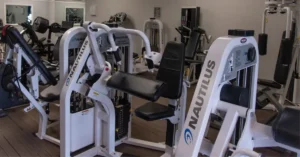
This is the idea behind the best exercise machines. Exercise machines use a pulley system attached to the weight stack that work around cams, which are mechanically shaped components that change the leverage of the resistance as you move through an exercise. The cam on a machine is designed to match the strength curve of the exercise you are performing, and even the playing field. In other words, when your joints are at a mechanical disadvantage, the machine adds an advantage, and vice versa. The goal is to provide a more consistent muscular challenge throughout the range of motion rather than having one position become the limiting factor.
Not All Machines Are Built the Same
Not every exercise machine uses variable resistance in the same way. Many machines found in standard gyms use simple pulley systems with circular discs rather than specifically engineered cams designed to alter leverage throughout the movement. Because the resistance remains relatively consistent while your mechanical advantage changes, these machines may not provide the same advantages as properly engineered variable-resistance equipment.
The best exercise equipment is designed to account for the changing strength curve of the muscles throughout an exercise. When the equipment can adjust the leverage as you move, it can provide a more consistent challenge to the target muscles and help eliminate some of the limitations of traditional free weights.
The Exercise Equipment Checklist
When evaluating exercise equipment, I recommend looking for these characteristics, in order of importance:
- Minimize unnecessary loading. Avoid equipment that places substantial external resistance on the spine or other structures that don’t need to bear the load. Instead of placing a barbell on your back, look for alternatives that allow you to effectively challenge the target muscles without unnecessary spinal compression.
- Promote proper body position. Look for equipment that helps maintain appropriate anatomical alignment throughout the exercise. If you can train the same muscle groups with greater support and control, there may be little reason to introduce additional demands simply to stabilize your body during the movement.
- Allow you to control range of motion. The appropriate range of motion isn’t necessarily the maximum range of motion your joints can physically achieve. Look for equipment that allows you to establish a safe range of motion and prevent yourself from moving beyond it. Why rely on chance when you can help ensure safety?
- Provide appropriately variable resistance. Look for equipment that changes resistance to better match your strength curve throughout the exercise. Properly engineered cams can alter leverage as you move, helping provide a more consistent muscular challenge instead of allowing one position to become the limiting factor.
The goal isn’t to find equipment that makes exercise easier. The goal is to make your muscles work hard without making the rest of your body work unnecessarily hard to accomplish it.
That’s the difference between simply exercising and training with purpose. For those reading who are local and wanting to experience training with a purpose first-hand, book a Free Training Session with the button below.