

Where Most Glute Training Falls Short
There’s a moment many women reach in their fitness journey where they question what’s not working, especially when it comes to glute training.
They’re exercising consistently. They’ve watched the influencers with their beautifully shaped glutes, and added in the glute workouts, resistance bands, maybe even heavier weights. And yet, the results don’t seem to match the effort.
Building your glutes isn’t about doing more exercises. It’s about doing the right exercises in a way that actually challenges the muscle, and then progressing that challenge over time.
The glutes are strong, foundational muscles, but they’re also very easy to “miss.” If the exercise selection or the way the exercise is performed is off, your body will naturally shift the work into other areas like the lower back or quads. This is why exercise selection and performance matter so much. Maintaining control is what allows the glutes to stay engaged and actually be the muscle doing the work.
At Rock Solid Fitness, this is a core principle of our High Intensity Safe Strength Training® method. The focus is not on doing more, but on doing what works—with precision, control, and progression.
Certain exercises become far more effective when performed with this level of intention. Hip abduction, for example, is often skipped, rushed, or treated as a light accessory movement, but when done slowly and with control, it directly targets the outer glutes and contributes to both shape and stability. This targeted area helps give a rounder appearance to the outer curve of the glutes.
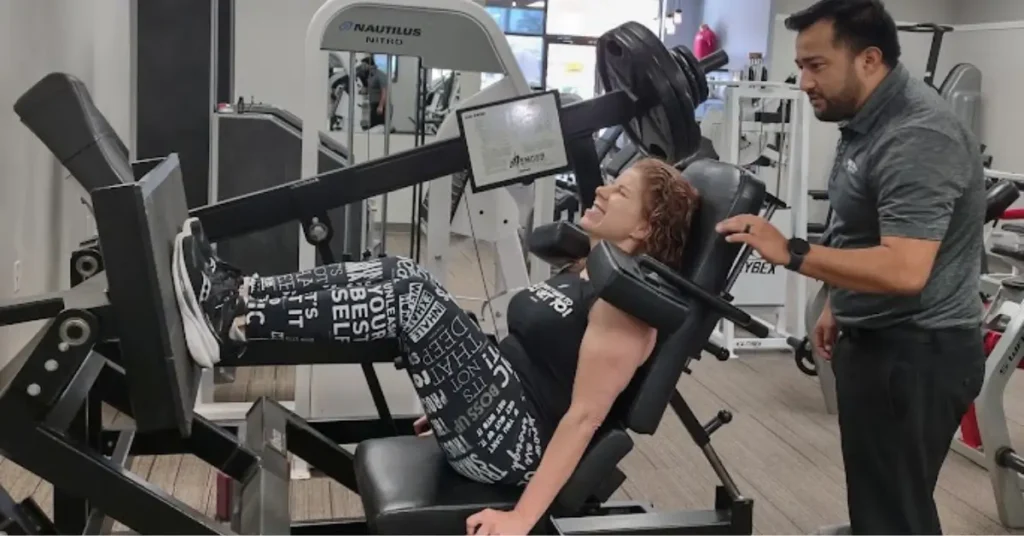
A leg press can be an excellent glute exercise when used correctly. Using a leg press with a rotary component to the movement is particularly important for targeting more glutes and less quads. Positioning and control determine whether this becomes a glute exercise or simply another quad-dominant movement.
Reverse lunges are another valuable movement because stepping backward allows for better control, less stress on the knees, and often leads to stronger glute engagement. The focus should be on pushing through the front heel and controlling the entire movement, rather than simply completing the reps.
There are also machine-based movements, like a 45-degree setup, that can be adjusted to target the glutes more directly. When the body is positioned correctly, specifically with the pivot point aligned at the hips, the glutes can drive the movement. It is important to maintain a neutral spine so the lower back muscles remain stable, putting the stress on the glutes while keeping it off the lower back. As with everything else, control and alignment determine the effectiveness.
But even when all of this is in place, there’s one factor that ultimately determines whether your glutes will change: progressive overload of resistance.
Muscle is built through progressive overload, which simply means the demand placed on the muscle gradually increases over time. This doesn’t require large jumps in weight, but it does require increasing the resistance over time. Small, consistent increases, combined with good form, are what create long-term results.
This is a fundamental part of how we target glute training at Rock Solid Fitness. Every workout is designed with progression in mind, ensuring that the body is continually challenged in a safe and effective way.
There’s also something else that’s important to acknowledge, and it’s often overlooked: genetics.
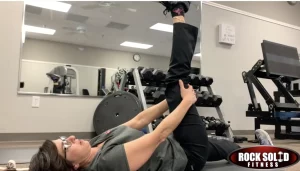
Do you have tight muscles, poor posture, or spend your entire work day at a desk? Then you might be in need of a stretching routine to loosen up those muscles, reverse your bad posture, or wake up without that stiff neck. Start your new stretching routine habit with minimal time, and minimal equipment — most of which you already likely have at home.
Many women over the years have said, “I want a butt that looks like…” and then fill in the blank with the influencer or star that has the most amazing glutes in their opinion.
One of my favorite stories is of a woman who brought a picture to her trainer of her most desirable-looking glutes and told her trainer that she wanted hers to look just like the one in the picture. The trainer’s answer was, “Do you have the same parents?” The woman said, “No.” The trainer’s response: “If you don’t have the same genetics, you won’t have the same glutes.”
Every person has a unique structure—different muscle shapes, different muscle lengths, and different capacities for growth in certain areas. Some women will naturally develop fuller glutes more easily, while others may need more time and consistency to see visible changes.
This doesn’t mean progress isn’t possible. It just means that your end result will be your own.
Comparing your body to someone else’s, especially in a world curated by fitness models, influencers, AI images, and idealized physiques, can set unrealistic expectations. The more productive focus is on improving your own strength, your own muscle development, and your own consistency over time.
When training is approached with a mindset focused on execution, progression, and individual potential, the process becomes far more effective—and far more sustainable.
Building your glutes is not about chasing variety or copying workouts. It’s about understanding how your body responds to resistance and giving it the right stimulus, over and over again, until it adapts.
If you’ve been putting in the effort and not seeing the results you expect, there is a better way to approach your training.
We would love to help guide you through a smarter, safer, and more effective approach to building strength that lasts. See what our Palm Harbor members, and members from all around our community, are raving about. Try out a commitment-free workout for free.